
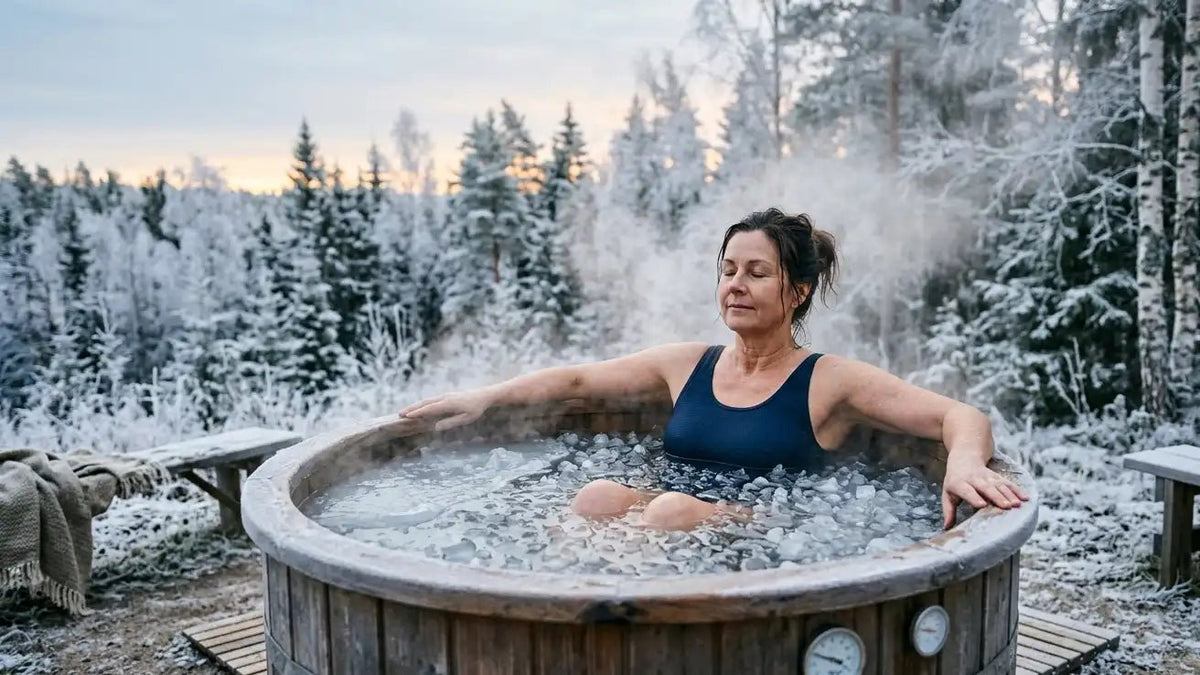
There is no single ideal ice bath temperature for everyone. For post-exercise recovery, cold-water immersion research commonly uses temperatures around 10–15°C (50–59°F), but this is a research context—not a universal recommendation. Research on recovery protocols does not justify treating one range as universally optimal. Colder is not automatically better, and temperature should be considered together with immersion time, health, and the purpose of the session.
What Does the Research Say About Ice Bath Temperature?
Cold-water immersion has been studied for post-exercise soreness and recovery. A Cochrane review found some evidence of reduced muscle soreness compared with passive recovery, but the studies varied in their methods and were generally small. The review did not establish an optimal method or settle questions about safety.
A temperature used in an experiment describes the conditions researchers tested. It does not prove that the same temperature is best for a beginner, a different training goal, or someone with a health condition. Recovery findings also do not guarantee that every person will feel less sore.
Ice Bath Temperature: Celsius to Fahrenheit
Water temperatures are often shown in Celsius in research and Fahrenheit in US product settings. The following values are conversions for reference, not recommended settings for every person.
| Celsius | Fahrenheit |
|---|---|
| 5°C | 41°F |
| 10°C | 50°F |
| 12°C | 53.6°F |
| 15°C | 59°F |
| 18°C | 64.4°F |
A temperature commonly used in research is not automatically suitable for an individual. Consider immersion time, health conditions, and the purpose of the session.
Should Beginners Use a Warmer Ice Bath?
Beginners do not need to chase the coldest possible water. A more conservative approach may be appropriate, but there is no single evidence-based temperature progression for everyone. Cleveland Clinic's cold-plunge guidance emphasizes starting cautiously and considering health risks.
Feeling more accustomed to cold is not a reason to follow an automatic beginner-to-advanced ladder. Neither experience nor a warmer setting guarantees safety. This guide does not prescribe a fixed starting temperature, exposure time, or schedule for lowering the temperature.
For more on getting started, see our first ice bath guide.
How Do Water Temperature and Immersion Time Relate?
Water temperature and immersion time both affect cold exposure. A temperature tested in a research study does not establish how long every person should remain in the water. There is no universal temperature-and-time combination that guarantees safety or recovery benefits.
For a separate discussion of immersion duration, read our ice bath duration guide.
Consider the Training Context
Short-term recovery and long-term training adaptation are different outcomes. A systematic review of cold-water immersion after resistance training suggests that repeated cold-water immersion immediately after resistance training may attenuate muscle-growth adaptations, although the authors note that the overall quality of the available evidence is limited.
Effects may differ by training context and outcome. This finding does not establish a universal waiting period after exercise, and choosing a particular water temperature does not remove that uncertainty.
Measure the Water Temperature
Do not estimate water temperature by feel alone. Use a thermometer suitable for water, following its instructions, and confirm whether the reading is in Celsius or Fahrenheit. Measure before entering and recheck when conditions change, such as after adding ice.
Starting water temperature, water volume, ice amount, ambient conditions, insulation, and circulation can affect the final reading. There is no fixed ice-to-water ratio that will produce the same temperature in every setup. Avoid relying on a single reading taken next to a piece of ice to represent the whole bath.
Ice or a Chiller for Temperature Control?
Ice can lower water temperature, but the temperature may change as the ice melts and ambient conditions change. Measure the result rather than assuming a particular amount of ice will produce an exact temperature.
A chiller can make target-temperature control and repeatability easier, depending on the equipment and setup. If that control is useful for your routine, you can explore GARVNIVE cold plunge chillers. This is a temperature-control option, not a requirement tied to how often you use an ice bath or a guarantee of a medically appropriate setting.
Safety Matters at Any Temperature
The American Heart Association explains that sudden cold-water immersion can rapidly affect breathing, heart rate, and blood pressure. Cold exposure can contribute to hypothermia, and risks can continue after leaving the water. Very cold water should not be treated as an advanced-user goal.
Consult a healthcare professional before starting cold-water immersion if you have a cardiovascular condition or other health concerns. Following Cleveland Clinic's guidance, leave the water if you feel lightheaded or experience discomfort beyond the sensation of cold. No temperature range in this article guarantees safety.
For related precautions, see our ice bath risks guide. A thermometer helps you measure exposure conditions; it does not establish that those conditions are suitable for you.
FAQ
What Is the Ideal Ice Bath Temperature?
There is no single established ideal for everyone. Around 10–15°C (50–59°F) is a commonly studied range in post-exercise recovery, not a universal prescription. The purpose of the session, immersion time, and individual health all matter.
Is 50°F / 10°C Cold Enough for an Ice Bath?
Yes, 50°F (10°C) falls within temperatures used in cold-water immersion research. You do not need to go below it simply to make a bath count as an ice bath. Its use in studies does not establish that it is suitable or safe for every reader.
Should Beginners Use a Warmer Ice Bath?
A cautious approach is more appropriate than chasing the lowest reading. However, there is no universal beginner setting or validated progression schedule, and warmer water is not a safety guarantee.
Is a Colder Ice Bath More Effective?
Not automatically. Effectiveness depends on the outcome being measured and the conditions studied. A finding about one recovery measure does not establish that colder water is better for every goal or person.
How Do You Keep an Ice Bath at a Consistent Temperature?
Use a thermometer and monitor changes in the water and surrounding conditions. Ice requires adjustment as it melts; a suitable chiller can make temperature control more repeatable. Neither method eliminates the need to measure the water or consider health risks.
Share:
Do Ice Baths Actually Work? A No-Fluff Guide to Cold Water Therapy
How Many Ice Baths a Week?